Personal brand statement examples for founders
 Vaibhav Yadav · Founder, Be No Stranger · 21 October 2026 · 9 min read
A personal brand statement says who you help, what result you create for them and why you are the right person to do it, and it has to be short enough to fit inside your LinkedIn headline, which gives you only 220 characters. Your company is already out in the public domain, but people do not know the person behind it, and a good personal branding statement fixes that, as long as you avoid the mistake most founders make, which is writing it like a company brochure.
Most founders can explain their company in a minute, but very few of them can explain themselves in a sentence, and that sentence is your personal brand statement, which is one of the most useful things you can write for your LinkedIn profile. This guide explains what a personal brand statement is in plain language, how to write one, and shows examples for founders that you can adapt, and it also covers the mistake I see more than any other, which is founders describing themselves like a company brochure.
What is a personal brand statement?
A personal brand statement is a short statement of who you help, what result you create and why you can be trusted to do it. It is not a slogan and it is not your biography, and it answers the question a stranger asks the moment they land on your profile, which is why they should keep reading. It also sits underneath almost everything else you do on LinkedIn, from your headline and the opening lines of your About section to the way you introduce yourself on a call, so when you get it right once, the rest gets a lot easier to write.
What personal branding actually means for a founder
Here is the simplest way I explain it to a founder who has never heard of it.
You have your company out in the public domain. Everyone knows the company. But people do not know you: the mastermind behind it, the architect behind it, the one leading the show.
Personal branding is putting yourself out there so people know what you, as a founder, are doing. You tell your stories. You tell people about you and your perspective and your opinions. You talk about your hardships, your failures and your struggles. You talk about a time when everything seemed futile and then panned out in a different direction. You talk about the battles that no one has heard of that shaped you.
It is not about becoming a creator
This is the part founders get nervous about, so let me be clear. Personal branding is not about having a creator personality or becoming a creator.
It is just about putting yourself in front of other humans, who are already human. You tell them: this was a time I was facing this problem. I was not in good shape. The business was tanking. Then I took this decision, and it turned out to be pivotal.
That is a story and not a performance, and once you have done that, you will be able to understand what your personal brand statement needs to say, because it comes from things that actually happened to you.
Why your LinkedIn headline matters
The problem with a LinkedIn headline is that you only get 220 characters to make an impact, and that same space is also doing the work of showing up in search, so if you do not use it properly it becomes a problem, because you simply cannot say what you need to say in it. The usual mistake is leading with the company and assuming that everyone already knows what that company is, when they do not, and a headline built from your personal brand statement works much harder because it says who you help and the result you create, instead of just a job title and a logo.
Here is a real one, which is my own headline: "I help founders become impossible to ignore on LinkedIn". It is a single line, and it tells you who I help and what happens for them.
How to write a personal brand statement
Start with the formula and then fill it with specifics from your own story.
Formula: I help [specific buyer] get [specific result] by [how you do it], because [why you can be trusted].
Begin by naming your buyer, and be specific about it, because "businesses" is not a buyer. Then name the result they get, which is what actually changes for them, and say how you do it in one short phrase. After that, add why you can be trusted, and this is where your own story goes, whether that is the time you faced the problem yourself or the experience that shaped how you work. A full statement can run to two sentences, but for your headline you will need to cut it down to one line inside 220 characters. Finally, read it from the other person's side, because when you are out in the public domain you have to write it through people's eyes and not your own. You know what you want to do with your profile and what you do not, but the person landing on it only knows what the page tells them.
Personal brand statement examples
Here is a real example, followed by examples that show the format, and those are illustrations rather than real clients.
Real example: "I help founders become impossible to ignore on LinkedIn."
Format examples you can adapt:
- SaaS founder: I help finance teams stop losing hours to manual reconciliation, because I ran finance operations for years before building the product that fixes it.
- Consultancy founder: I help mid-sized manufacturers cut supplier risk by mapping the weak points in their supply chain before they cost money.
- Health-tech founder: I help clinics reduce missed appointments with reminders patients actually respond to.
- Web3 founder: I help everyday users take their first step into digital assets without needing to understand the technology first.
What every one of them has in common is a specific buyer, a specific result and a reason to believe the person saying it.
The mistake we see founders make most
The most common thing I see founders get wrong when they describe themselves is that they put it out like a company brochure. The way to think about it is that people should know that this person created this company, and not that this company created this person, so your company becomes part of your identity, and you do not turn your own identity into the company.
In practice, that means whatever traffic you get on your profile, you can redirect to your website, but it does not work the other way round, because you cannot send people to a company page and then convert them and cash in, as it is never really about that. Humans like to buy from humans, and if your customers know that they can reach out to the founder and the product owner at any time, that is one of the main core strengths in the small business and service-based sectors. You are not running a retail food chain where you operate in a few places and people have no idea what you are doing or what you are not doing.
Where to use your personal brand statement
Once you have it, use it in your LinkedIn headline, cut down to one line inside 220 characters, and in the first two lines of your About section, which are the only lines people see before "see more". Use it in your banner as one clear promise, and use it as the way you introduce yourself on calls, on podcasts and at events.
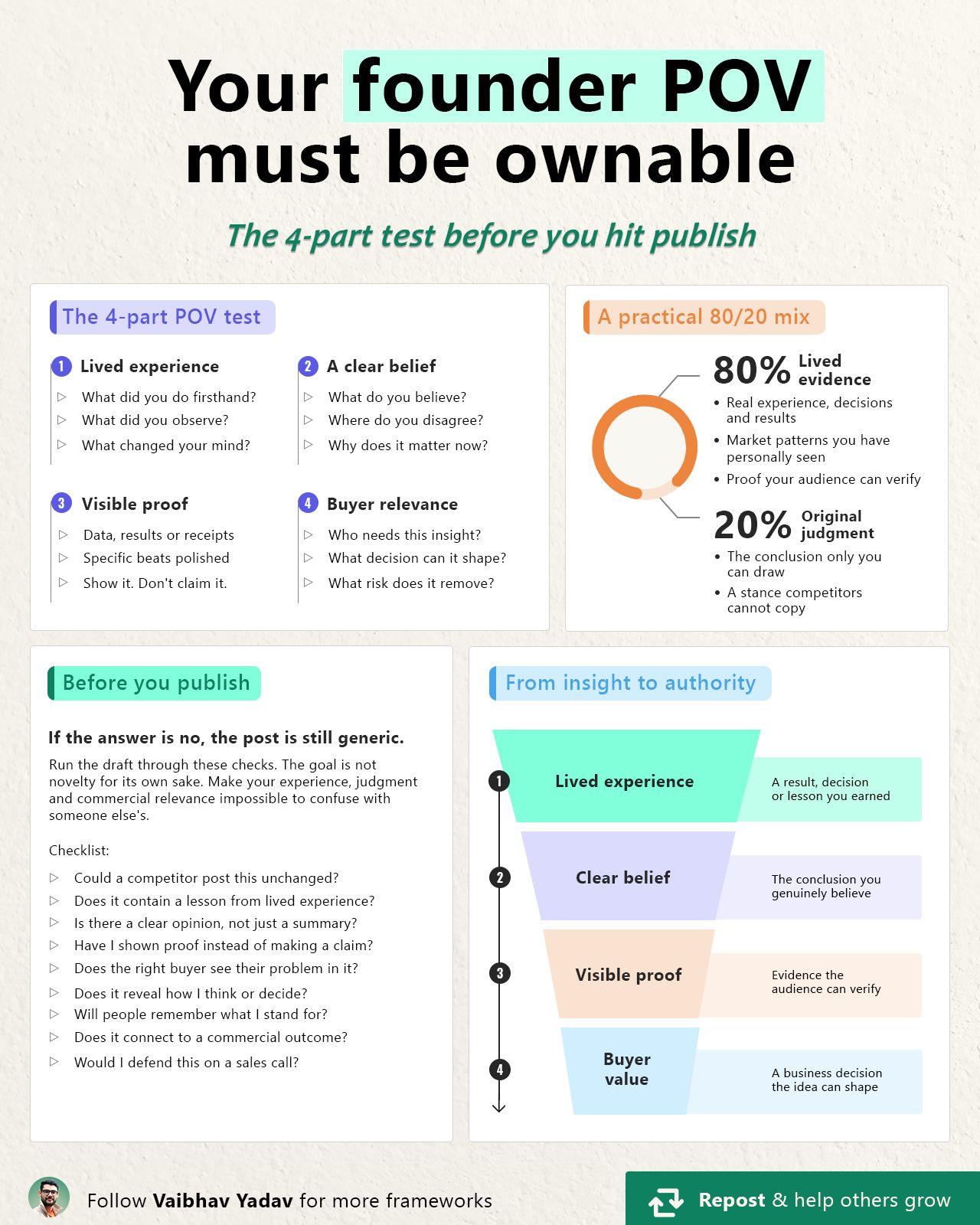
For what goes in each section of your profile, use our LinkedIn profile checklist for founders, and to test whether your story is strong enough to build a point of view on, try the 4-part founder POV test.
Want a person to look at yours?
If you would like someone to look at how your profile reads, start with a free profile audit, which is a short video teardown recorded by a person, and if you want us to rebuild it for you, see our LinkedIn profile optimization service.
Frequently asked questions
What is a personal brand statement?
It is a short statement of who you help, the result you create and why you can be trusted, and it answers the question a stranger asks when they land on your profile, which is why they should keep reading.
How do you write a personal brand statement?
Use the formula "I help [specific buyer] get [specific result] by [how you do it], because [why you can be trusted]", fill it with specifics from your own story, and then cut it down to fit your LinkedIn headline.
How long should a personal brand statement be for LinkedIn?
Your LinkedIn headline allows 220 characters, so the headline version needs to fit inside that, while a fuller version can run to one or two sentences in your About section.
What is the biggest mistake founders make with their personal brand statement?
They describe themselves like a company brochure, when people should know that this person created this company and not that the company created the person.
Is personal branding the same as being a content creator?
No, because personal branding is about putting yourself in front of other people and telling the real stories, opinions and struggles behind your business, and it does not mean becoming a creator.
Where should founders use their personal brand statement?
In the LinkedIn headline, in the first two lines of the About section, in the banner, and in the way they introduce themselves on calls and at events.